
A 121-page plain-language field guide for operators and young engineers: how towers work, monitoring, testing, troubleshooting and cooling water chemistry.
USD 24
| Format | PDF, A4, 121 pages, 44 diagrams and charts |
| Edition | Edition 1.1 (October 2026) |
| Readers | Operators and junior engineers; useful refresher for seniors |
| Units | SI first, US in brackets |
| Sources | Perry, GPSA, Marley/SPX, CTI, Betz and others — cited in our own words |
| Free sample | Chapters 1–3 |
Single-user licence. Team and site licences: see options. Instant download after payment; you also get updates to this major version.
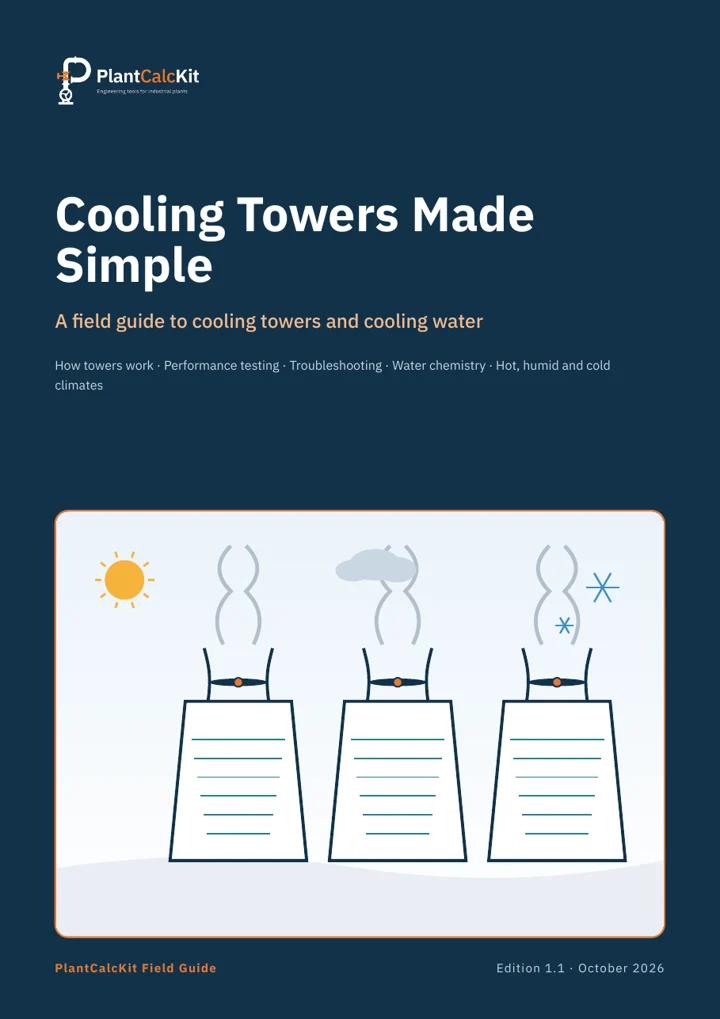
What it does
16 chapters, 121 pages, 44 diagrams
From how a tower works to water chemistry, upkeep, energy and water saving.
Three climates
Every topic shown for a hot-dry, a hot-humid and a cold site.
For the shift and the desk
Field checks, one-minute shift checks and engineer's calculation corners in each chapter.
Troubleshooting guide
Fault-finding order, symptom tables, real fault stories and when to escalate.
Cooling water chemistry
Every parameter, the four water problems, Legionella and a step-by-step treatment programme — generic chemistry, no supplier names.
Printable extras
Checklists, log sheets, a one-page tower card, quizzes, glossary and FAQ.
What's inside
- Why plants need cooling towers
- How a cooling tower works
- Types and parts
- What changes tower performance
- Performance monitoring
- Thermal performance testing
- Reading the results
- Troubleshooting guide
- The water balance
- Cooling water chemistry, parameter by parameter
- The four water problems
- Controlling the water
- Mechanical upkeep and inspection
- Saving energy and water
- Worked examples at three sites
- Small towers, big towers and the economics of size
Plus appendices: glossary, printable checklists and log sheets, quick reference, quiz answers, FAQ and a sample report from readings to a decision.